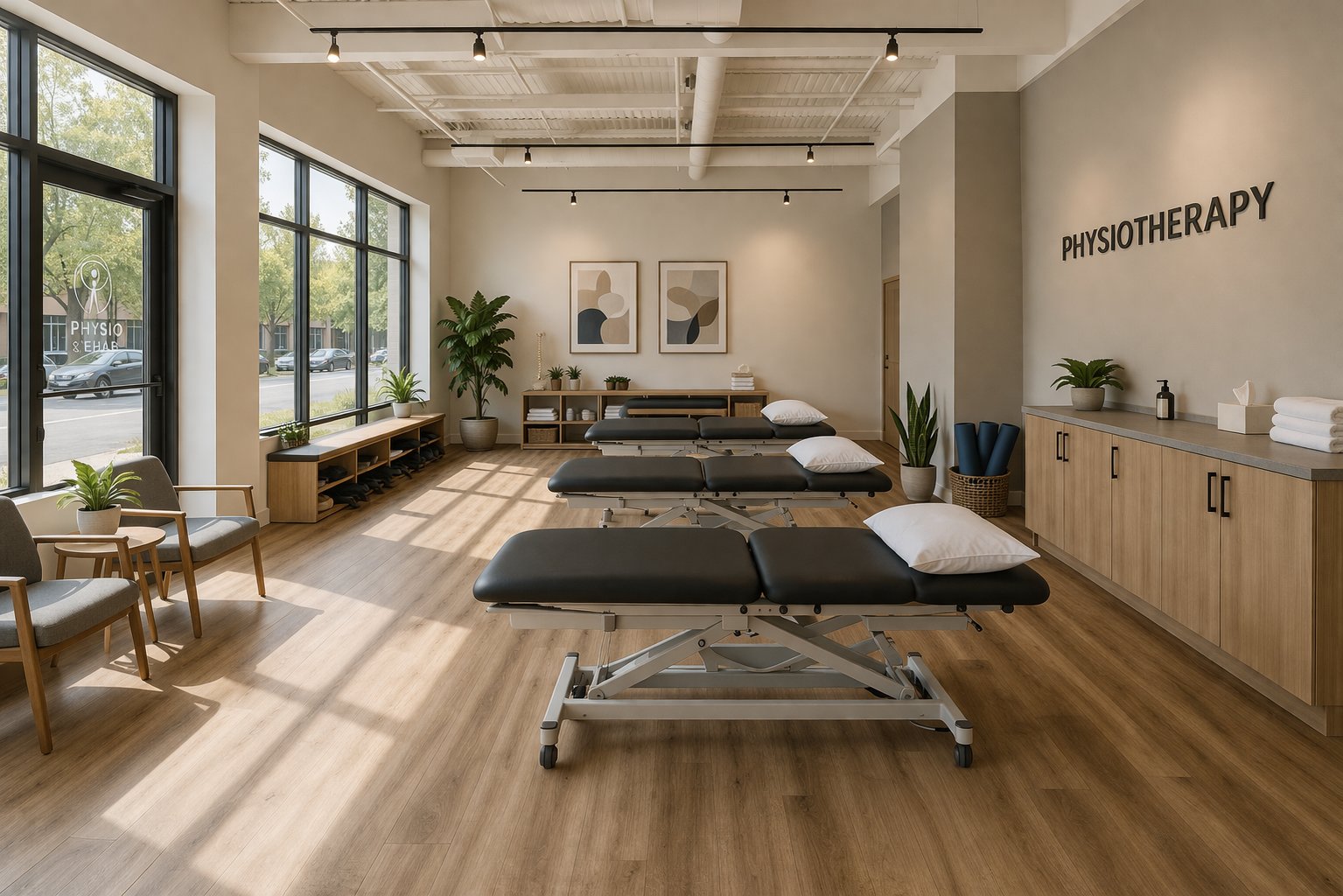
Allied health practitioners — physiotherapists, chiropractors, occupational therapists, psychologists, speech-language pathologists, audiologists, naturopathic doctors, and the full spectrum of regulated health professionals — face a healthcare real estate market largely designed around the needs of physicians. Medical office buildings, their standard lease forms, and the assumptions embedded in landlord improvement allowances reflect a physician-tenant model that does not map cleanly onto allied health clinic formats.
Physiotherapy and Rehabilitation
A physiotherapy clinic has fundamentally different space requirements than a medical office. Open treatment bays — not examination rooms — are the core clinical unit. Bay dimensions must accommodate a plinth, a practitioner, and sufficient lateral space for exercise and mobilization work. Where hydrotherapy is offered, pool infrastructure and associated structural loading, waterproofing, and humidity management systems require landlord engagement from the earliest stage of lease negotiation. Equipment loading — for rehabilitation gyms with significant free weight and cable machine installations — must be assessed against the building's structural floor loading capacity. HVAC provisions must account for the higher metabolic rate of patients in active rehabilitation — air change rates adequate for a sedentary medical office are frequently insufficient for an active physiotherapy clinic.
Chiropractic
Chiropractic clinics share some characteristics with physiotherapy but also have specific requirements around x-ray capability where the practice includes diagnostic imaging. Lead-lined x-ray rooms are a structural requirement that must be addressed in the landlord work letter and reflected in the permitted use clause. Landlords who have not previously hosted chiropractic tenants may be unfamiliar with these requirements and resistant to the associated costs.
"Allied health practitioners are sophisticated clinical operators with specific space requirements. The standard medical office lease was not designed for their practices — and the gap matters."
Psychology and Mental Health
The single most critical space specification for a psychology or mental health clinic is acoustic privacy. A patient in therapy must have absolute confidence their conversation cannot be heard in adjacent spaces. This requires either purpose-built sound attenuation — STC ratings materially higher than standard commercial drywall partition construction — or careful selection of spaces where physical separation from adjacent tenants provides natural acoustic privacy. Mental health clinic site selection should also account for entrance discretion — patients often value access that does not require passing through a shared lobby, reducing perceived stigma.
Lease Structure Considerations
Allied health practitioners often underestimate the importance of renewal options and assignment rights in their lease negotiations. A physiotherapy practice that has built a loyal patient panel over five years at a particular address has a genuine location-dependent asset — one that can be destroyed by a landlord's decision not to renew. Renewal options, clearly specified and with rent escalation caps, are non-negotiable for any allied health practitioner entering a multi-year clinical lease.
PRAXIS advises allied health practitioners and networks on clinic leasing, site selection, and build-out advisory across Ontario and Alberta. Contact Mya Qi, MPH.


