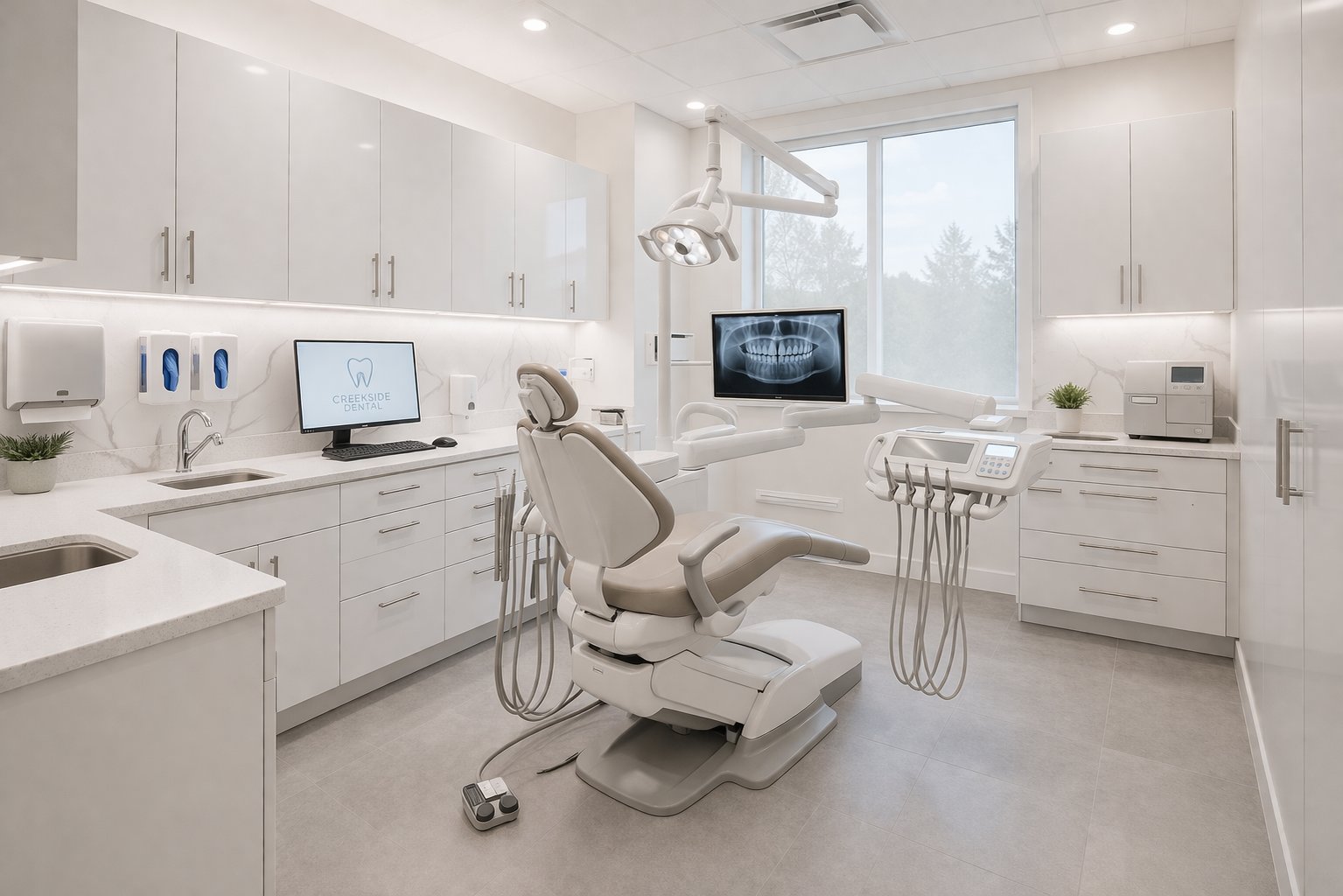
A dental clinic lease is not a standard commercial lease with a dental tenant inside. It is among the most technically demanding occupancy agreements in healthcare real estate — and among the most consequential for a practitioner's long-term financial wellbeing. Dentists who sign without dedicated advisory routinely discover, years into a term, that their lease contains provisions that were negotiable at signing but are now entrenched — provisions constraining clinical operations, exposing them to unforeseen costs, or complicating a future practice sale.
The Technical Infrastructure Requirement
Dental clinical space has a specific infrastructure requirement distinguishing it from general medical office use. Compressed air supply lines serving each operatory chair, dental vacuum systems, nitrous oxide where applicable, and plumbing rough-ins for chair count are mechanical systems that must be designed into the base building or landlord-provided infrastructure. X-ray suites require lead-lined walls — a structural requirement that cannot be retrofitted cost-effectively after a lease is signed without full landlord cooperation. Sterilization room design must be explicitly addressed in the lease and associated work letter. HVAC provisions for operatory areas, including infection control air change rates and air pressure relationships, should meet or exceed ASHRAE 170 guidelines for dental occupancies.
"For a multi-site dental operator, the quality of the lease portfolio is a direct input to enterprise value. Leases that constrain expansion, complicate assignment, or create exposure to arbitrary rent escalation reduce the value of the business."
The DSO and Multi-Site Context
Canada's dental sector is in an accelerating consolidation driven by Dental Support Organizations. DSOs acquiring or affiliating with established dental practices create multi-site portfolio structures requiring sophisticated real estate management across dozens or hundreds of clinical locations. For a DSO, the real estate portfolio is a core business asset — lease terms, renewal options, assignment rights, and co-tenancy provisions must be managed at portfolio level, not practice by practice.
Site Selection Considerations
Dental clinic location decisions are driven by visibility, parking, co-tenancy, and catchment demographics. Ground floor in a medical office building, inline in an anchored retail plaza, or standalone pad — each carries different lease economics and patient access profiles. The presence of complementary co-tenants generates patient referral and visibility value that should inform site selection and lease negotiation.
The Investor Angle
Dental clinic real estate has attracted meaningful investor interest as consolidation has created larger, more creditworthy tenant entities. A DSO-operated dental clinic with a ten-year corporate-guaranteed lease represents a meaningfully different credit profile than a solo practitioner on a personal guarantee. Investors evaluating dental real estate should pay close attention to the guarantor structure, the term remaining, and the clinical infrastructure quality — particularly HVAC, plumbing, and x-ray shielding provisions.
PRAXIS advises dentists, orthodontists, oral surgeons, and DSOs on clinic leasing, development, and acquisition across Ontario and Alberta. Contact Mya Qi, MPH.


