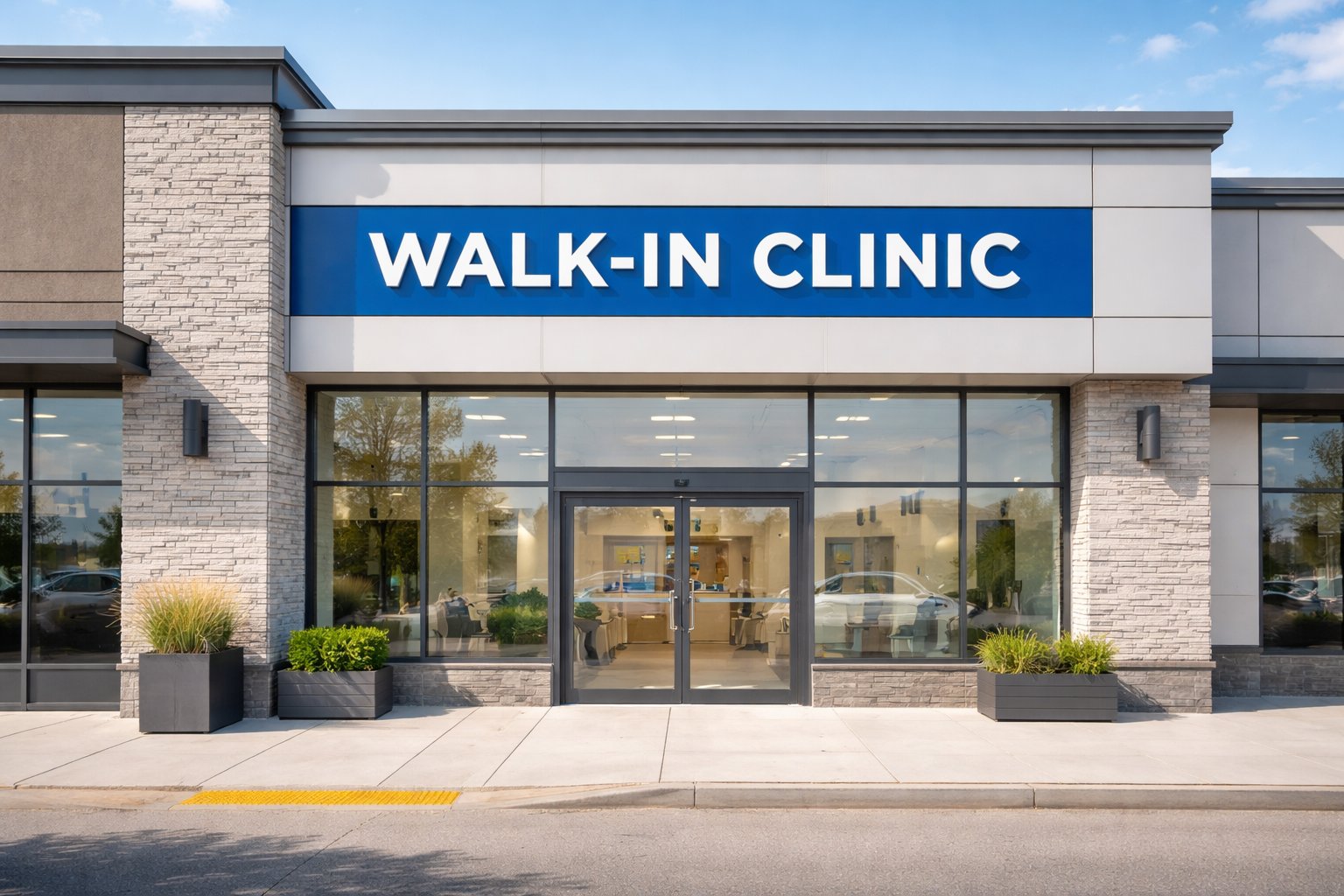
Walk-in and urgent care clinics occupy a unique real estate niche in the healthcare facility spectrum. Unlike medical offices whose patient base is captive and whose location is somewhat forgiving of visibility constraints, walk-in clinics compete directly for the attention of patients in the moment of healthcare need — patients who may choose among several accessible options based on what they can see from a road, a parking lot, or a search result that lists proximity and hours. The real estate decisions for a walk-in clinic are inseparable from its competitive positioning.
The Location Logic
Successful walk-in clinic locations share a consistent set of characteristics: high daily traffic volume, surface parking with direct access, visible signage from primary arterial roads, and proximity to residential density. The presence of complementary co-tenants — a grocery anchor, a pharmacy, a medical office building — generates the ambient foot traffic and errand-trip bundling that drives spontaneous walk-in clinic visits. A location requiring a dedicated trip, with no other reason to visit the surrounding area, underperforms compared to one embedded in a daily errand ecosystem.
Ground floor is non-negotiable. Second-floor walk-in clinics consistently underperform their ground-floor counterparts regardless of signage quality. The friction of elevator access — even a trivial friction — materially reduces walk-in conversion rates, particularly for acutely unwell patients and elderly patients with mobility considerations.
"Walk-in clinic real estate is retail real estate logic applied to a healthcare context. Visibility, access, and co-tenancy are the primary variables — clinical layout is secondary to location."
The Urgent Care Distinction
Urgent care centres — offering higher acuity clinical scope including diagnostic imaging, IV therapy, minor procedural capability, and extended triage capacity — have different real estate requirements. The clinical infrastructure requirement is higher: more plumbing, more electrical capacity, medical gas provisions, and in some formats, diagnostic imaging equipment with radiation shielding requirements. These infrastructure needs push urgent care clinics toward purpose-built facilities or medical office building space — the inline retail strip format that works well for standard walk-in clinics is frequently insufficient for urgent care.
Lease Considerations
Walk-in clinic lease negotiations involve specific considerations. Visibility provisions — requiring the landlord to maintain exterior signage opportunity and prevent adjacent tenants from obstructing sight lines — are important for a business model where spontaneous patient acquisition is a key driver of volume. Extended hours of operation, which are intrinsic to the walk-in model, must be explicitly permitted in the permitted use clause and reflected in the landlord's building operating hours provisions.
Network Expansion Strategy
For walk-in clinic operators pursuing multi-site network expansion, the real estate strategy must balance standardization — consistent format, equipment specifications, patient experience — with the flexibility to accommodate specific characteristics of each market. Renewal options should be structured to prevent simultaneous multi-site lease expirations that create portfolio-wide renegotiation risk.
PRAXIS advises walk-in clinic operators and urgent care networks on site selection, lease negotiation, and multi-site expansion strategy across Ontario and Alberta. Contact Mya Qi, MPH.


